



In early February, a second cold front moved across Florida, closely following an already significant drop in temperatures. Overnight lows reached levels cold enough to stress planted environments across much of the state, reigniting familiar conversations about plant damage, cold tolerance, and what belongs in Florida landscapes.
For many, these moments feel at odds with Florida’s identity. The state is widely perceived as tropical—defined by warmth, lush growth, and mild winters. That perception shapes expectations, particularly when it comes to landscape design. Cold weather is often treated as an interruption rather than a condition to plan for.
In reality, cold snaps are a normal part of Florida’s climate. While their severity and duration vary from year to year, periods of colder air have always been part of the state’s seasonal rhythm. Certain climate patterns amplify their frequency or intensity, but the presence of cold itself is not unusual from a long-term planning perspective.
What these moments tend to reveal is not a failure of the climate to behave as expected, but a disconnect between how Florida is imagined and how it actually functions.
When temperatures drop, the impact on landscapes is rarely uniform. Some plantings show immediate stress—leaf burn, dieback, stalled growth, or complete failure—while others absorb the change with comparatively minor disruption. These differences are often attributed to the cold itself, when in fact they stem from decisions made much earlier: assumptions about climate, resilience, and what conditions a landscape should be expected to withstand.
Cold snaps do not introduce new challenges so much as they expose existing ones. They act as a stress test, revealing whether landscapes were designed around an idealized version of Florida or the full range of conditions that occur here with regularity.
It is within this context that native plant palettes become especially relevant. Not because they eliminate risk, but because they reflect a deeper understanding of place—one that accounts for variability rather than ignoring it.
Florida’s Climate Is Cyclical, Not Static
Florida’s climate is often described in broad, simplified terms, but its reality is far more dynamic. Seasonal shifts, atmospheric patterns, and long-term climate cycles all influence how conditions unfold from year to year. Periods of intense heat may be followed by cooler winters. Wet seasons can swing toward drought. Calm years give way to more volatile ones.
This variability is not a modern development, nor is it unpredictable in the context of long-term observation. Florida’s ecosystems—and the plant communities that evolved within them—are shaped by these cycles. They reflect adaptation to fluctuation rather than stability.
Design challenges arise when landscapes are conceived as though conditions are static. When plant selection assumes uninterrupted warmth, consistent rainfall, or narrow temperature ranges, even modest deviations can create outsized impacts. Cold snaps, in particular, tend to expose this fragility quickly because the damage is visible and immediate.
Plants adapted to Florida’s native conditions are not immune to stress, but they are accustomed to it. Their growth patterns, dormancy responses, and recovery mechanisms are shaped by seasonal change. Cooler temperatures trigger predictable reactions rather than systemic failure.
Over time, this distinction becomes significant. Landscapes designed with an awareness of climatic cycles tend to recover more reliably after disruptive events. Their performance remains consistent, even when conditions temporarily fall outside the ideal. Landscapes designed around narrower assumptions require more frequent intervention to correct, replace, or compensate for what was never well suited to begin with.
Understanding Florida as a cyclical environment—not a fixed one—fundamentally shifts how landscapes should be planned. It encourages decisions that prioritize durability over immediacy and long-term performance over short-term appearance.
From that perspective, native plant palettes are not a conservative choice. They are a practical one.
Why Native Plants Are Built for These Conditions
Native plants are often described as “hardier,” but that shorthand doesn’t fully capture why they perform more consistently in Florida landscapes—especially during periods of environmental stress.
The advantage of native plants lies in adaptation. Over time, Florida’s native plant communities developed in response to the state’s full range of conditions: heat and humidity, heavy rainfall and drought, nutrient-poor soils, storms, and seasonal temperature fluctuations that include periodic cold. These plants are not optimized for perfection; they are optimized for variability.
During cold snaps, this distinction becomes particularly visible. Native plants tend to respond to colder temperatures in predictable ways. Growth may slow. Leaves may show minor cosmetic damage. Some species enter temporary dormancy. Importantly, these responses are part of a natural cycle rather than signs of failure.
Plants that evolved in consistently tropical environments often lack this flexibility. When exposed to temperatures outside their narrow comfort range, their physiological systems struggle to adjust. The result is not simply slowed growth, but structural damage that can compromise long-term health or lead to complete loss.
Recovery is another critical factor. Native plants generally rebound more quickly once conditions normalize. Their root systems, energy reserves, and growth cycles are aligned with Florida’s seasonal rhythms, allowing them to resume normal function without extensive intervention.
This difference matters beyond a single weather event. Landscapes are not experienced in snapshots—they are lived with over time. Plants that repeatedly struggle under predictable conditions require ongoing correction, replacement, or redesign. Plants that recover reliably contribute to landscapes that mature as intended.
Cold snaps, then, are not an argument for or against any single plant species. They are a demonstration of how well—or how poorly—plant selections align with the realities of place. Native plants consistently show that alignment because they are shaped by the same forces that continue to define Florida’s environment today.
The Long-Term Advantages of Native Plant Palettes
While cold weather often brings attention to plant selection, the benefits of native plant palettes extend far beyond a single season or event. Their value becomes most apparent over time, as landscapes are asked to perform year after year under shifting conditions.
Environmental Alignment
Native plants are inherently suited to Florida’s soils, rainfall patterns, and hydrology. This compatibility allows landscapes to function more efficiently as part of their surrounding environment rather than in constant opposition to it.
Because these plants evolved within local ecosystems, they are better adapted to available resources. Their water needs align more closely with natural precipitation patterns. Their root systems interact predictably with native soils. This alignment reduces stress during periods of excess or scarcity and supports more stable growth over time.
Predictability and Performance
One of the most underappreciated advantages of native plant palettes is predictability. Landscapes built around plants that respond consistently to seasonal change are easier to plan for and manage. Growth patterns are more reliable. Seasonal shifts are anticipated rather than disruptive.
This predictability preserves design intent. When plants behave as expected, the structure, scale, and visual composition of a landscape remain legible over time. Designers, planners, and property stewards can trust that what is envisioned will continue to function as intended rather than unraveling under environmental pressure.
Resilience Through Variability
Florida’s climate demands resilience not just to one type of stress, but to many. Native plant palettes offer a form of built-in adaptability. They are accustomed to periods of heat, saturation, dryness, and cold, often within the same year.
This adaptability reduces vulnerability during extreme events. While no landscape is immune to disruption, native-based designs tend to absorb shocks more gracefully. Damage is more often temporary than catastrophic. Recovery is faster. The need for reactive decision-making is reduced.
Stewardship and Longevity
Over the long term, native plant palettes support a more responsible approach to land planning. They encourage working with environmental systems rather than continuously correcting against them. Landscapes become assets that age with their surroundings instead of liabilities that require constant reinvention.
This approach reflects a broader commitment to stewardship—one that recognizes landscapes as living systems with long life cycles. Native plants contribute to landscapes that endure, adapt, and remain relevant as conditions change.
Taken together, these advantages make a compelling case for native plant palettes not as a stylistic preference, but as a strategic foundation for landscape planning in Florida.
The Hidden Risks of Non-Native and Tropical-Forward Palettes
Non-native and tropical-forward plant palettes are not inherently flawed, but they do carry risks that are often underestimated—particularly in regions like Florida, where environmental variability is a given rather than an exception.
Many times, tropical plants are chosen specifically for the visual impact they have on a location. And, of course, under ideal conditions, they perform well. But those ideal conditions tend to be narrower and less forgiving. When temperatures fall outside that range, even briefly, the consequences can be disproportionate.
Cold snaps make this vulnerability visible. Plants not adapted to cooler temperatures often show rapid decline, and recovery is uncertain even after conditions improve. Damage may extend beyond foliage into stems and root systems, undermining long-term health. In some cases, failure is not immediate but cumulative, weakening plants over multiple stress events until replacement becomes inevitable.
Beyond cold tolerance, non-native palettes frequently introduce a broader pattern of inconsistency. Growth may be unpredictable. Seasonal transitions may disrupt design intent. Visual gaps appear where plants fail to perform as expected. Over time, landscapes require increasing levels of correction to maintain coherence.
These challenges are not always recognized at the outset. They emerge gradually, often framed as maintenance issues or isolated failures rather than symptoms of a deeper mismatch between plant selection and environment.
From a planning perspective, this creates a cycle of reaction. Resources are redirected toward replacement, mitigation, or redesign. The landscape becomes something to manage around rather than rely on. What began as a design decision turns into an ongoing operational concern.
In contrast, landscapes grounded in environmental compatibility tend to behave more predictably. Their challenges are anticipated rather than surprising. Their performance aligns more closely with long-term expectations. Over time, this distinction becomes less about preference and more about responsibility.
How Lucido & Associates Approaches Plant Palette Recommendations
At Lucido & Associates, plant palette recommendations are not treated as a stylistic decision made late in the process. They are an integral part of early planning—shaped by regional conditions, site-specific realities, and the long-term role a landscape is meant to play within its broader context.
Rather than beginning with trends or aesthetic preferences, the process starts with place. Climate patterns, soil conditions, hydrology, exposure, and surrounding land uses all inform how a landscape is expected to perform over time. Plant selection follows from that understanding, not the other way around.
Native plant palettes are often recommended because they align most closely with these realities. Native species bring a level of predictability that is difficult to replicate with plants adapted to different climates or narrower environmental ranges. They respond more consistently to seasonal shifts, recover more reliably from stress events, and integrate more seamlessly into Florida’s ecological systems.
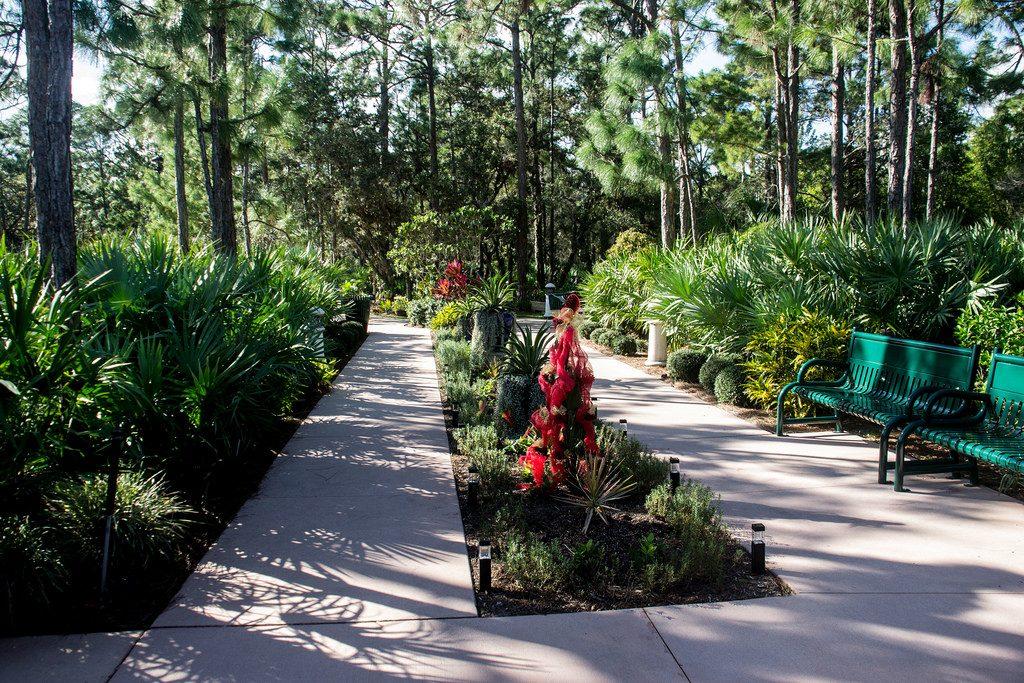
This philosophy guides real projects. At Kanner CPUD, better known as the Costco on Kanner Road, a native-first strategy shaped the landscape framework from the earliest stages of planning. Rather than defaulting to visually tropical selections, the palette was intentionally grounded in species adapted to local soils, hydrology, and climate variability. The goal was not simply aesthetic cohesion, but durability—ensuring that the landscape would perform consistently across seasonal shifts and environmental stressors. That approach, explored in “Why That Plant? A Native-First Approach to Designing Resilient Landscapes at Kanner CPUD,” demonstrates how early, place-based plant decisions influence the long-term success of a community.
That recommendation is not dogmatic. There is no single formula applied across every project. Instead, native plants are evaluated as part of a larger strategy—one that prioritizes durability, adaptability, and long-term stewardship over short-term visual impact.
This approach reflects a broader philosophy of planning for conditions as they exist, not as they are hoped to be. Florida’s landscapes are shaped by variability: heat, rain, drought, storms, and periods of cold. Designing within that framework requires acknowledging those forces rather than designing in spite of them.
When native plant palettes are incorporated thoughtfully, the result is not simply a landscape that survives challenging conditions, but one that maintains its integrity through them. The design intent remains legible. The landscape matures as anticipated. The need for reactive decision-making is reduced.
Native Does Not Mean Limiting Design
One of the most persistent misconceptions surrounding native plant palettes is that they restrict creativity or lead to monotonous outcomes. In practice, the opposite is often true.
Florida’s native plant communities offer a wide range of forms, textures, colors, and seasonal variation. When these plants are composed thoughtfully, they support layered, dynamic landscapes that evolve throughout the year. Seasonal shifts become features rather than disruptions, adding depth and interest rather than detracting from the overall design.
Design within environmental constraints often leads to stronger outcomes. Constraints clarify priorities. They encourage intentional composition rather than reliance on novelty. When plant selections are grounded in performance, design energy can focus on structure, spatial relationships, and long-term experience.
Native palettes do not dictate a single aesthetic. They support a spectrum of expressions, from formal to naturalistic, depending on how they are applied. What they consistently offer is a foundation of reliability—one that allows design intent to endure rather than erode.
What the Recent Cold Snap Reminds Us
The recent cold snap across Florida did not change the fundamentals of landscape planning. It reaffirmed them.
Moments like this bring clarity. They highlight which landscapes were designed with an understanding of place and which were built around assumptions that only hold under ideal conditions. They remind us that climate variability is not an interruption, but a defining characteristic of Florida’s environment.
Native plant palettes are not a reaction to cold weather. They are a response to long-term reality. They reflect an approach to planning that values foresight over expedience and alignment over appearance.
When landscapes are designed with these principles in mind, weather events become moments of confirmation rather than disruption. The work holds. The intent remains clear. The landscape continues to function as part of its environment, not in opposition to it.
In a state defined by change, designing for what is consistent—variability itself—may be the most responsible choice of all.


