
The end of the year has a way of creating space for reflection—an opportunity to step back from the pace of day-to-day work and consider not just what has been completed, but how it came to be. The projects that reach completion are visible. The work behind them—the deliberation, coordination, and responsibility that shape them long before ground is broken—often is not.
For Lucido & Associates, reflection carries a particular weight. Founded by Thomas Lucido in 1988, the firm has spent nearly four decades working within the communities it serves, contributing to their growth while remaining deeply connected to the places and people that define them. Over time, Martin County and the surrounding regions have evolved—economically, environmentally, and culturally—and Lucido & Associates has been present through that evolution, offering steady guidance grounded in experience, professional judgment, and respect for place.
While the landscape of development has grown increasingly complex, the firm’s approach has remained rooted in consistency. Regulations shift. Projects become more layered. Expectations rise. Yet the foundation of the work—remaining closely involved, understanding every facet of a project, and taking personal responsibility for its success—has never changed. This commitment is not abstract; it is practiced daily, shaped by decades of experience and reinforced by the understanding that every project leaves a lasting imprint on the community it serves.
It is often this steadiness that clients recognize first. Long before an introduction is made, the firm’s reputation has already arrived—shared through professional relationships, municipal partnerships, and word-of-mouth built over years of dependable collaboration. In an industry where trust is earned slowly and lost quickly, that reputation has become one of Lucido & Associates’ most enduring assets.
Making Complexity Manageable
Development work is, by its nature, complex. It requires an understanding of land, regulation, community priorities, long-term viability, and the often-unspoken realities that exist between them. For many clients, that complexity can feel overwhelming—not because it is unfamiliar, but because so much is at stake. Decisions made early have lasting consequences, and missteps are rarely isolated.
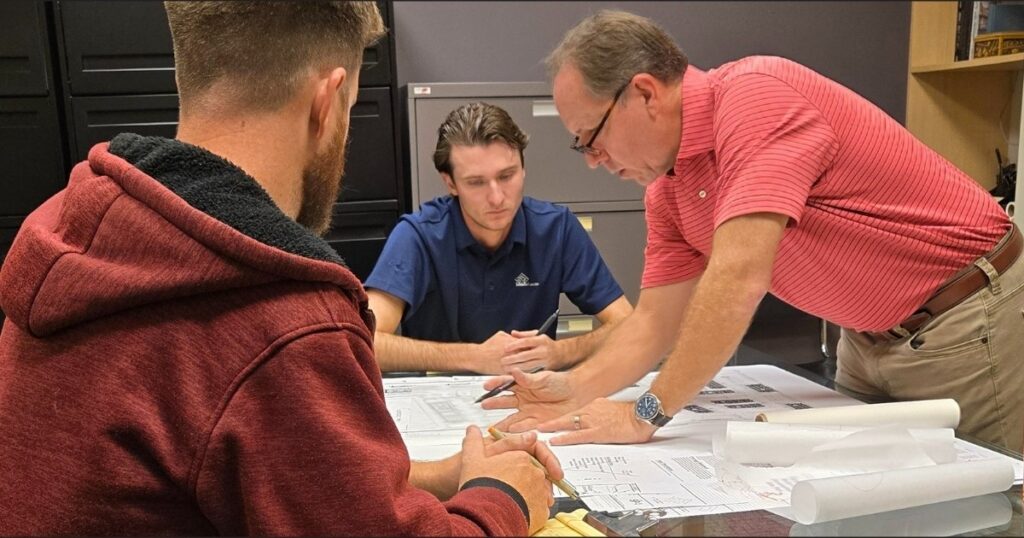
At Lucido & Associates, complexity is not something to be avoided or minimized; it is something to be understood fully and navigated deliberately. This begins with an approach that is deeply personal. When the firm takes on a project, it does so with the expectation that partners will remain closely involved, bringing decades of experience directly into the process rather than operating at a distance. As Steven Garrett often says, the team “eats, breathes, and sleeps” its client projects—a phrase that reflects not intensity for its own sake, but accountability.
This level of involvement allows challenges to be addressed early, often before they surface as problems. Nuances in entitlement, municipal process, or site conditions are identified with the benefit of long institutional knowledge and long-standing professional relationships. Rather than reacting to obstacles as they arise, the work is guided by anticipation—by an understanding of how projects move through real-world conditions, not just theoretical ones.
For clients, this translates into a process that feels steady and manageable, even when the work itself is complex. Communication remains clear. Decisions are informed. Progress is deliberate. The result is not a simplified project, but a clearer path forward—one shaped by experience, consistency, and a genuine investment in the outcome.
A Broader Understanding of the Work
Landscape architecture, at its best, doesn’t exist in isolation. It sits at the intersection of planning, architecture, infrastructure, and experience—shaped as much by coordination and judgment as by design itself. At Lucido & Associates, this understanding has long informed how projects are approached, allowing the firm to move fluidly across disciplines while maintaining clarity and cohesion.
Over decades of practice, our team has developed the ability to anticipate and coordinate elements that do not always immediately come to mind when one thinks of landscape architecture, yet are essential to how a place ultimately functions and is perceived. Hardscape systems, signage and wayfinding, public art, circulation patterns, and the integration of built and natural elements all require careful consideration and alignment. Each carries its own set of technical requirements, aesthetic implications, and stakeholder interests.
Rather than treating these components as isolated tasks, Lucido & Associates approaches them as interconnected parts of a larger whole. This allows the firm to serve as a steady point of coordination—bridging gaps between disciplines, consultants, and decision-makers, and ensuring that no element is resolved in a vacuum. The result is not an accumulation of individual solutions, but a cohesive framework in which each piece reinforces the next.
This breadth of understanding is especially valuable on complex projects, where misalignment between disciplines can lead to inefficiencies, delays, or diluted intent. By remaining closely involved and maintaining a comprehensive view of the work, Lucido & Associates helps guide projects toward outcomes that feel resolved rather than negotiated—clear in purpose, consistent in execution, and grounded in long-term use.
Thoughtful Design in Action: Veranda Falls
Veranda Falls is a commercial project, but it was never conceived as a standalone destination. From the outset, it was understood as part of a broader, carefully considered landscape—integrated into a larger master-planned community and shaped by its relationship to the residential neighborhoods, public spaces, and civic elements that surround it.
Situated adjacent to Veranda Gardens, a residential project in which Lucido & Associates also played a role, and just down the street from Spinnakers on Becker Road, the large-scale public art installation that has become a recognizable landmark in its own right, Veranda Falls reflects a continuity of thinking that extends beyond property lines. The project is connected not only physically, but philosophically—designed to contribute to a cohesive sense of place rather than operate in isolation.
Fun fact: This was one of the first projects to integrate public art (the bronze statues throughout the water features and property) before the CIty of PSL had a public art ordinance.
What distinguishes Veranda Falls is the degree of intentionality applied to every aspect of the environment. While it functions as a commercial plaza—active, accessible, and well-used—it was designed to feel less like a conventional shopping center and more like a quiet retreat. Integrated art elements interact with the outdoor spaces rather than simply occupying them, appearing to engage with the water features, pathways, and landscaped areas that shape the experience of moving through the site.
Multiple water features, layered landscaping, and thoughtfully designed circulation create moments of pause, inviting visitors to linger rather than rush through. Even the signage system was approached with long-term adaptability in mind, coordinated to allow for change over time without disrupting the overall visual language of the plaza. These decisions reflect an understanding that commercial environments must evolve, and that good design anticipates that evolution rather than reacting to it.
In this way, Veranda Falls illustrates the value of Lucido & Associates’ comprehensive approach. It is a place shaped not only by technical expertise, but by an awareness of how people experience space—how they arrive, how they move, and how the environment makes them feel. The result is a commercial setting that serves its purpose while contributing something quieter and more enduring to the community it is part of.
Carrying this Work Forward
Projects like Veranda Falls are possible only when design is approached as a long-term responsibility rather than a short-term exercise. For Lucido & Associates, that responsibility is deeply personal. The firm does not simply work within these communities—it remains part of them, living alongside the outcomes of its decisions long after projects are completed. This proximity brings a level of care and accountability that cannot be replicated at a distance.
It is this enduring connection to place that has shaped the firm’s practice since its founding in 1988. Thomas Lucido established Lucido & Associates with the understanding that thoughtful planning and landscape architecture have the power to influence not only how land is used, but how communities grow, interact, and endure. That perspective continues to guide the firm today, informing both the work itself and the way it is carried out.
As a new year begins, Lucido & Associates finds itself in a moment of reflection—not to mark an ending, but to acknowledge continuity. The foundation remains unchanged: hands-on involvement, a comprehensive understanding of complex work, and a commitment to shaping places with intention and care. Looking ahead, a refreshed brand and redesigned website will offer a clearer window into that work, better reflecting the depth, experience, and thoughtfulness that have defined the firm for nearly four decades.
What lies ahead is not a departure from what has been built, but a natural evolution—an opportunity to tell the story more clearly while continuing to do what Lucido & Associates has always done: show up, stay engaged, and contribute meaningfully to the communities it serves.


