



If you’ve been watching Severance on Apple TV+, you’ve already seen the building. That vast, austere, glass-and-concrete monolith where Helly and Mark shuffle through endless identical corridors, haunted by the eerie feeling that their work life and home life have been surgically split in two? That’s real. That’s the Bell Labs Holmdel Complex, designed by Eero Saarinen and built between 1959 and 1962 — and for decades, one of the most intellectually fertile addresses in American science.
Four Nobel Prizes. Laser technology. Cellular technology. The cosmic microwave background radiation that confirmed the Big Bang. Not bad for one building in central New Jersey, surrounded by gently rolling hills and the kind of pastoral quiet that apparently inspires genius.
Our Severance from the Past
Industries, and years before Somerset Development brilliantly transformed it into “Bell Works” — what its developer Ralph Krieger famously dubbed a metroburb — our team at Lucido & Associates had our own vision for what this iconic campus could become.
We partnered with Hemisphere Development LLC, the internationally recognized IMG Academies, and Garcia Stromberg — the South Florida-based architecture and interior design firm founded in 1987 by Jorge Garcia and Peter Stromberg, whose work spans resort, hospitality, and mixed-use projects across the United States, the Caribbean, and Central America — to propose something genuinely ambitious: the IMG Resort Academies at Holmdel. The concept was adaptive reuse at its most imaginative — taking a landmark R&D campus sitting on 472 acres of gently rolling New Jersey countryside and reimagining it as a world-class sports, wellness, residential, and hospitality destination. Garcia Stromberg’s design sensibility was a natural fit for the project: their philosophy of site-specific, culturally grounded architecture, and their track record delivering high-end resort and mixed-use environments, brought exactly the right creative ambition to a building that demanded nothing less.
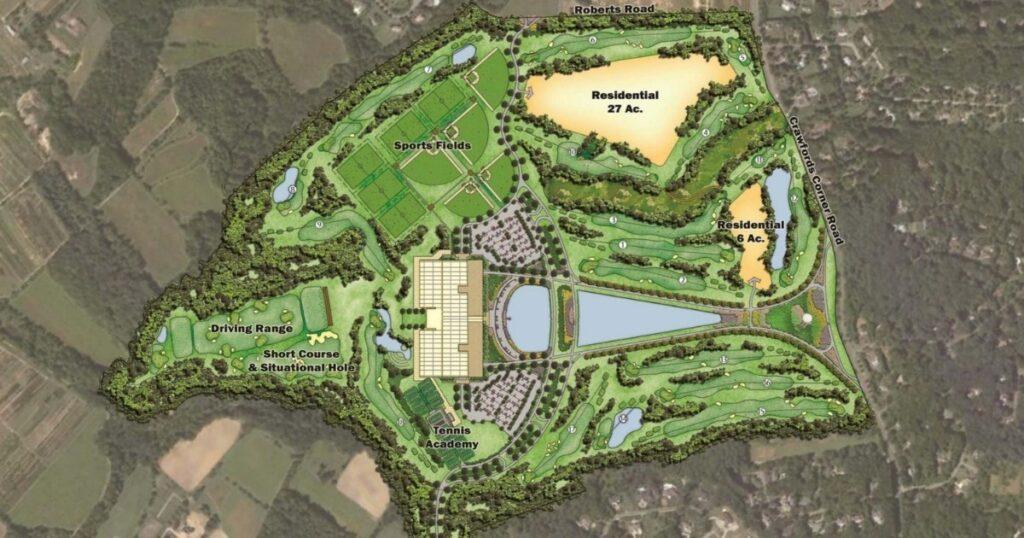
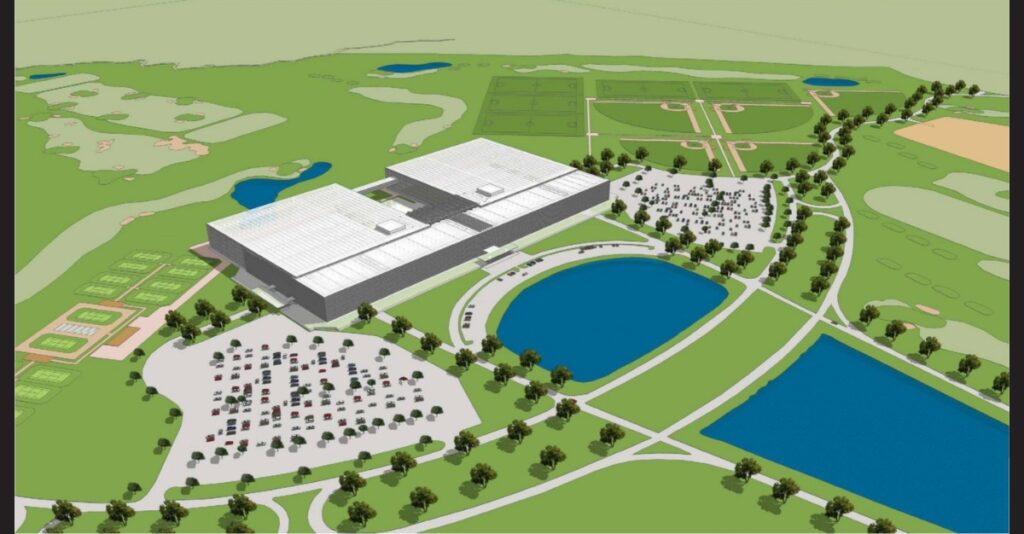
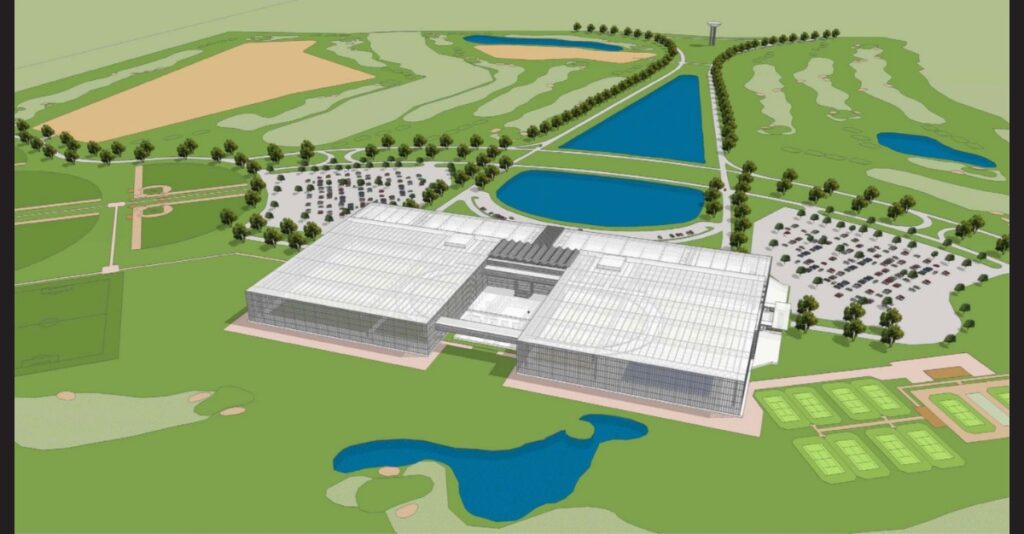
Think championship golf winding through the natural topography of the site. Tennis academies. A 250-room luxury resort hotel with a spa and conference center. A culinary institute. A health and performance center drawing on IMG’s thirty-plus years of training elite athletes. Residential enclaves integrated into the landscape. And anchoring it all, the Bell Labs building itself — reimagined as the campus centerpiece rather than an empty corporate relic.
The target market alone told the story of how well-positioned the site was. Within 60 miles: approximately 25 million people. Within 180 miles: an additional 55 million, plus the entire tourism draw of the New York metropolitan area. The property sat 40 miles from Midtown Manhattan, with rail access at Hazlet and Middletown stations, a proposed on-site helipad, ferry service from Belford Terminal, and Exit 114 of the Garden State Parkway practically at the front door. For a resort and sports academy concept, the location was almost absurdly good.
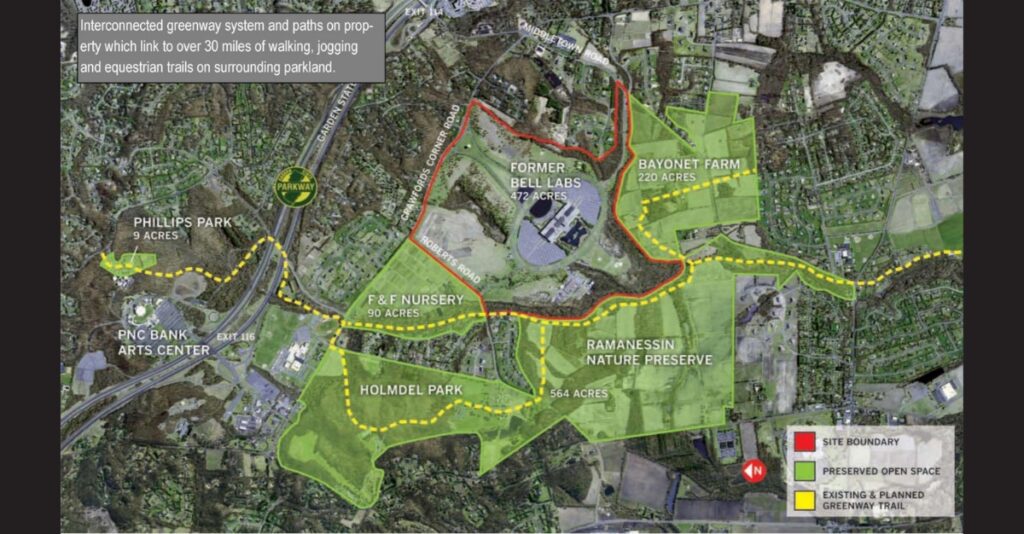
The land plan itself was one of the most intricate and satisfying design exercises our team has undertaken. We wove together the building’s iconic footprint with new outdoor sports fields — soccer, baseball, softball, football — alongside a tennis academy with 18 courts, a championship golf course complete with a learning and practice facility, and a driving range. A greenway system connected the development to over 30 miles of walking, jogging, and equestrian trails on the surrounding parkland, including Holmdel Park, Bayonet Farm, and the Ramanessin Nature Preserve. The landscape wasn’t just backdrop — it was infrastructure.
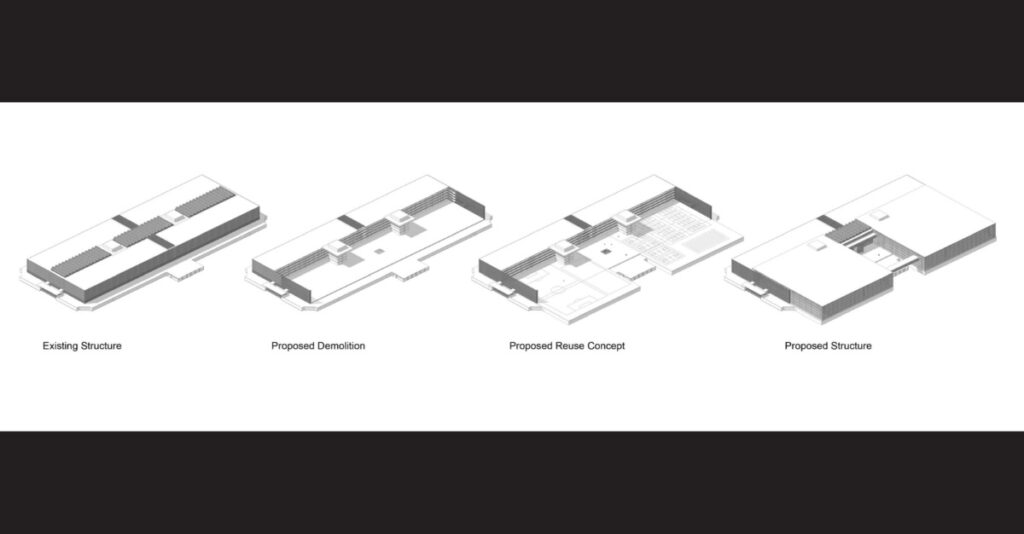
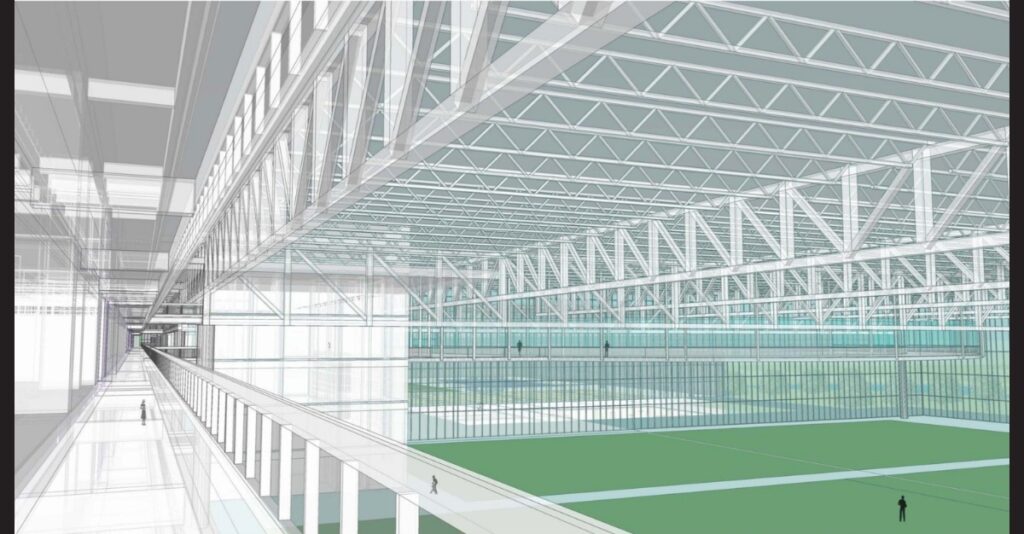
Internally, the Bell Labs building was to be reborn as something remarkable: aquatics, multi-surface sports fields, a natatorium, a culinary academy, spa and fitness facilities, a library, office and research space, hotel rooms lining the perimeter, and a Holmdel Historical Repository honoring the building’s extraordinary past. The architecture team developed a phased demolition and reconstruction concept that preserved the best of Saarinen’s original structure while opening it up to the active, light-filled programming the new use demanded.
The project didn’t go forward. Projects don’t always, and that’s part of the business. But the thinking was rigorous, the design was compelling, and the core instinct — that this building deserved a second life as a living, breathing community rather than an empty monument — turned out to be exactly right. Someone else eventually proved it.
What Adaptive Reuse Actually Means (and Why It Matters)
Adaptive reuse is planning shorthand for redeveloping an existing building or site for an entirely new purpose. In practice, it’s one of the most demanding and rewarding challenges a landscape architecture and planning firm can take on. You’re not working from a blank canvas. You’re inheriting decisions made by someone else — in this case, by Eero Saarinen, one of the twentieth century’s defining architects — and you’re trying to thread the needle between honoring what exists and creating something the community genuinely needs and can sustain.
The Bell Labs complex presented that challenge in almost extreme form. The building itself is architecturally significant. The site — nearly 500 acres of preserved New Jersey landscape — is ecologically and visually significant. The history is Nobel Prize-significant. Every design decision had to reckon with all three layers simultaneously, which is exactly the kind of constraint that separates interesting planning problems from ordinary ones.
Good adaptive reuse doesn’t erase a building’s identity; it reveals a new dimension of it. The Bell Labs campus was built around the idea that exceptional environments produce exceptional thinking — that the quality of the space shapes the quality of the work done inside it. That idea transfers remarkably well to a sports and wellness destination, where the environment is equally central to the experience. We were essentially arguing that the campus’s original philosophy was still valid; only the definition of “performance” needed updating.
Bell Works made a similar argument and executed it beautifully. Retail, dining, office tenants, community events, a healthcare facility — all organized around the building’s stunning interior atrium, which Saarinen designed to flood with natural light and encourage the kind of informal collision between disciplines that produces innovation. That instinct, too, carries forward.
The Lumon Twist
Here’s what makes the current moment so entertaining for anyone who’s been in the planning business long enough to remember this project: the building that generations of planners, developers, and architects puzzled over — what do you do with a structure this significant, this strange, this singular? — is now one of the most photographed interiors on television.
The long, humming corridors of Severance. The clinical break rooms with their motivational posters and carefully managed snack carts. The labyrinthine basement offices where the “innies” spend their entire conscious existence processing data they don’t understand for reasons they’re not permitted to know. The unnerving sense of a workplace that could be anywhere and nowhere, hermetically sealed from the outside world, buzzing with productivity that may or may not be entirely voluntary.
Eero Saarinen apparently built that atmosphere directly into the bones of the structure, and the show’s production designers — brilliantly — leaned into every square foot of it. The building’s scale, its repetition, its long sightlines and reflective surfaces, its sense of being complete and self-contained: all of it reads on screen as something between utopia and trap. Which, if you think about it, is also a fairly accurate description of how a lot of mid-century corporate campuses were intended to feel.
There’s something almost poetic about the arc. A building designed to house humanity’s most ambitious scientific minds became a symbol of dissociation and corporate control in one of the sharpest workplace satires in recent memory. And somewhere in between, it became a thriving mixed-use community that hosts farmers markets, live music, and a very good Italian restaurant.
We were part of one chapter of that story — a chapter that didn’t make it to production, so to speak, but that shaped how we approach large, historically weighted, architecturally significant sites to this day.
The Anti-Lumon Approach to Getting Things Done
There’s a recurring joke among people who’ve watched Severance that the show is basically a horror story about work-life balance — or rather, the complete surgical elimination of it. Lumon’s solution to the problem of employees who’d rather be somewhere else is elegant in its own dystopian way: simply remove the part of the brain that knows there’s anywhere else to be. Your innie clocks in, processes the numbers, goes home with no memory of the day. Your outie wakes up, lives their life, and never has to think about the office. Problem solved. Nobody’s miserable. Nobody’s anything, really.
We’ve tried a different approach.
Landscape architecture and planning is, at its core, a deeply human discipline. The best work we do doesn’t come from cleanly separating the person who shows up to the office from the person who goes for a hike on the weekend, coaches youth soccer, travels somewhere new, or sits in a restaurant and notices how the light hits the courtyard at a certain hour. It comes precisely from the bleed between those things. The planner who loves the outdoors designs better trail systems. The landscape architect who understands how families actually spend their weekends designs better community amenities. The person who pays attention to place — in their own life, not just professionally — brings something irreplaceable to a project like Holmdel.
That’s the philosophy that shaped our IMG Academies concept, and it shapes everything we do. We weren’t just drawing fields and fairways onto a site plan. We were thinking about how a family spends a Saturday, how a kid discovers a sport they love, how an adult finds an hour of quiet in the middle of a busy life. That kind of thinking doesn’t happen in a severance from lived experience. It happens because of it.
The building at the center of all this — the one Saarinen designed, the one Severance films in, the one we spent months imagining a new future for — was itself built on a version of that same idea. Bell Labs worked the way it did because it put brilliant people in a beautiful environment and trusted that the collisions between disciplines, between indoor and outdoor, between focused work and wandering conversation, would produce something extraordinary. It did. Repeatedly.
We’re not sure Lumon has figured that part out yet. But we’ll keep watching.
The Lesson We Carry Forward
Every site has memory. The Bell Labs campus in Holmdel is an extreme case — the memory includes Nobel laureates and the literal discovery of the universe’s origins — but the principle holds for every adaptive reuse project we take on, regardless of scale or profile. The land remembers what happened there. The building carries the imprint of the people who designed and used it. Our job as planners and landscape architects is to read that memory carefully, respect it honestly, and then bring enough creative confidence to propose something genuinely new.
That work requires listening before drawing. It requires understanding the ecology of a place, its infrastructure, its relationship to surrounding communities, its emotional register — and then designing in response to all of it, not just the physical constraints on the survey. It’s why landscape architecture and planning belong at the beginning of a project conversation, not after the architects have already committed to a massing.
Our IMG Academies concept for Holmdel was the product of exactly that process. We got deep into the site. We understood its access, its topography, its preserved open space, its regional market, its transportation links. We designed a land plan that felt inevitable for that particular piece of New Jersey geography — not something that could have been dropped anywhere, but something that could only have been there.
The project didn’t move forward. But the process made us better at the next one, and the one after that.
Sometimes you build something. Sometimes you watch from the sidelines as the place you spent months studying becomes something wonderful you didn’t quite imagine. And if you’re lucky, a critically acclaimed television series eventually films in the atrium, and you get to write a blog post connecting all the threads.
We’ll be watching Season 3 with a particular fondness for those hallways. And if anyone from the Severance production team ever needs a site plan, you know where to find us.
———-
Lucido & Associates is a Florida-based landscape architecture and planning firm with a 35+ year track record of award-winning projects across the private and public sectors. We specialize in master-planned communities, golf-course development, and adaptive reuse — and occasionally, walks down memory lane.


